issue no. 796
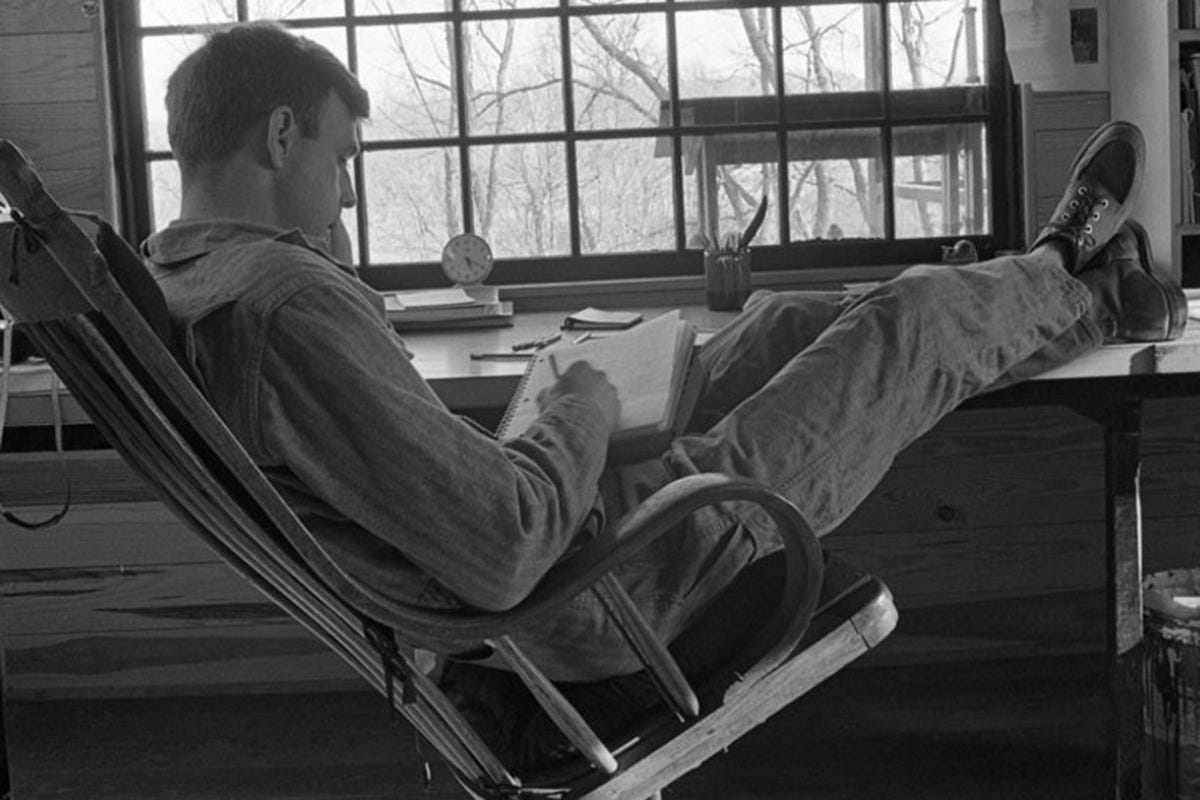
WENDELL BERRY DIED ON AUGUST 31 . . .
I found out from a friend the next morning. And after the initial thought of no, no, no, no… I found myself overtaken by that strange feeling of grief, where nothing much seems to matter.
I found that all I wanted to do was wander over to the bookshelf and take down that volume of Berry’s Sabbath poems, the one I took with a stack of other books from my dad’s house when I left it for the last time after he died, the house he had built with his own two hands, bringing my brother and I out to a patch of grass to stake out its four corners proudly, while we kicked the dirt and acted like nothing mattered, because we were teenagers.
It seemed like these were two very different instances, connecting my past to my present, both sending their urgent message of ‘nothing matters’…but I wonder if grief didn’t have everything to do with both of them.
With Berry’s book in my hands, inscribed to my father on his 46th birthday from family friends, I thought about how death stops everything for those who are left behind, and how the life in Berry’s poems does the same thing.
The two people I most want to talk to about Berry’s death are my two dead parents. When he died, I felt I lost them all over again. In a strange way, Berry embodied the two of them, which is no small feat given that they were like gunpowder and flame, together for a brief moment before exploding apart, leaving my ears ringing to this day. Processing the loss of Berry and all that he continues to give us, on into the future, I also felt my parents returned to me. As Berry writes in “The Man Born to Farming,” He enters into death yearly, and comes back rejoicing.
Each of my parents, in their different ways, made sure that Berry’s work and values were entwined with my understanding of my own life. Each of them is responsible for why, without knowing him, I felt stubbornly that Berry and I are, as they say in my home county, ‘kinned to’ one another. I suspect that every Kentuckian probably feels kinned to him, in some way. He is one of ours. He gave so many of his thoughts and visions and ideas to us all, that no matter where we hail from, he does belong to us, and therefore we belong to him. That’s the way belonging works, I think.
There’s a phrase I carry around with me: anything can be a spiritual act. Some of Wendell Berry’s choices, like not writing past daylight so as to avoid the use of strip-mined-coal-powered electricity, might seem puritanical. A certain type of perfectionism that does more harm than good. The word used in the New York Times obituary for Berry was ‘didactic.’ But that same article also said he was ‘not a household name,’ so I’ve been searching for other takes on his life since then, because he certainly was, in ours.
I think whether his choices resonated, or irritated, has to do with our understanding of a person who uses their voice as Berry did. There is power in using your voice, and a powerful person risks being put on a pedestal. An assumption gets made that he/she/they is extolling the One Right Way to live. Although this is a very human error to make, it obscures an important fact: we need people to challenge the status quo, because there is power in symbolic acts. And there is a big difference between someone who acts from their hunger for admiration, and someone with the curiosity and humility to try to live their values, with devotion.
I didn’t know Berry, or what the nature of his ego was, but it seemed like he most often fell into the latter category.
The subject line of this newsletter is taken from one of Berry’s many short, life-changing poems, “Our Real Work”:
“It may be that when we no longer know what to do
we have come to our real work,
and that when we no longer know which way to go
we have come to our real journey.
The mind that is not baffled is not employed.
The impeded stream is the one that sings.”
Recently, I went home to Kentucky, even though I don’t have much kin there anymore. I felt urgently called back home. I wanted somehow, some way, to connect my writing back to the place that made me. Afterward, I have had an increasingly strong feeling that it was my first trip back, not my last. That there is something waiting for me, between the place I came from and the writing I’ve waited my whole life to do. I don’t know what it is, but I know it’s there.
There are so many strong voices in the world, ready to say that nothing we do matters. That no small act on our part is going to make a difference in the world’s horrors. Those voices say, Why go without? Why miss out? Why be uncomfortable? Why be still or silent or uncertain? The easiest, most tempting dismissal that goes along with such questions, is that if you do so, you are a fool. Yet each day as I grow older, I am more skeptical of the unsolicited opinion that something doesn’t matter, or isn’t worthwhile. It reminds me of an essay I once read by the fall-off-your-seat-laughing writer, Samantha Irby, who essentially said that when people disparage something that you like, instead of feeling silenced and ashamed for liking it, you can simply say…”I like it!”
Likewise, when someone says dismissively, “Why would you do that?” you might simply say…”Because it matters to me.”
I think the perception that Berry had some grand moralizing to sow over the entire population of his listeners was actually another way of dismissing him - an attempt to banish the fear and discomfort that his radically simple, radically human work can provoke. I think if you read his writing, you’ll find as I have that he is filled with the contradictions and imperfections of being human, and that you have a choice about how to respond.
Instead of succumbing to the noise of dismissal, you might sit quietly with the thoughts that his work brings up in you. Listen to the questions he is asking. Notice how he pays attention to what matters to him. Consider that he is asking you to join him in this noticing. Wonder what it would feel like to do so.
“Then what is afraid of me comes
and lives a while in my sight.
What it fears in me leaves me,
and the fear of me leaves it.
It sings, and I hear its song.”
- from A Timbered Choir
Dor + Tay
“He enters into death yearly, and comes back rejoicing.”
- Wendell Berry, from “The Man Born to Farming”
tidbits...
resources on anti-racism, environmentalism and food culture AKA stuff we’re reading / listening to / watching / noticing / thinking about / captivated by this Tuesday . . .
Do One Small Thing . . . what is a small but radical act of resistance that you feel drawn to do in your life, but that you suspect - or are outright told - doesn’t really matter? We’d love to hear from you - reply to this newsletter, share in the comments, or email us at info@goodfoodjobs.com.
The Berry Center, which puts Wendell Berry’s writings to work by advocating for small farmers, land-conserving communities, and healthy regional economies, is hiring a Seasonal / Part Time Bookseller.
Barbara Kingsolver remembers Wendell Berry (NYT gift link).
I appreciated this Kentucky Lantern article on Wendell Berry’s life and legacy.
Adam Wilson reflects on how Wendell Berry’s life work impacted his own.
Our dear friend Gina Lorubbio has woven Wendell Berry’s work into her art in a way that inspires us.
Get your copy of Dorothy’s new poetry collection - online, from your favorite local bookstore, by asking your local library to carry it, or requesting it on the Libby app.
View and share this free guide to How to Write a More Equitable Job Post, and stay tuned for new resources to deepen this work.
got a tidbit? drop it here for us and we’ll share it in next week’s newsletter.